


Cruciate Ligament Disease
What is Cruciate Ligament Disease?
The cranial cruciate ligament (CCL) is one of the major stabilising ligaments within the knee (stifle) joint. It helps prevent excessive forward movement and rotation of the tibia.
When the ligament becomes damaged or ruptures, the joint becomes unstable, leading to pain, inflammation, lameness, and eventually osteoarthritis.
-
One of the most common orthopaedic conditions in dogs
-
Can occur suddenly or develop gradually over time
-
May affect one or both hindlimbs
-
Often progresses to arthritis if left untreated
-
Commonly seen in active, overweight, middle-aged, and large breed dogs
Severities
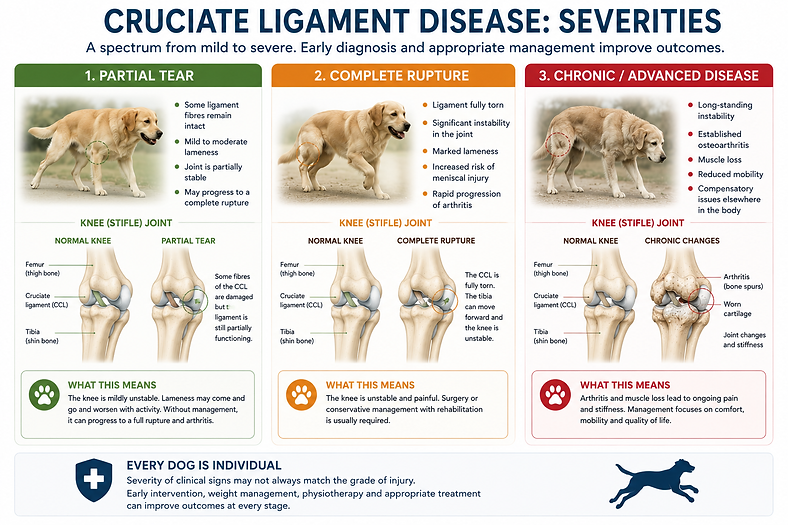
Partial Tear
-
Some ligament fibres remain intact
-
Mild to moderate lameness
-
Joint remains partially stable
-
May progress to a complete rupture
Complete Rupture
-
Ligament fully torn
-
Significant instability within the joint
-
Marked lameness
-
Increased risk of meniscal injury
-
Rapid progression of arthritis
Chronic Disease
-
Long-standing instability
-
Established osteoarthritis
-
Muscle loss
-
Reduced mobility
-
Compensatory issues elsewhere in the body

Symptoms
Common signs may include:
-
Sudden hindlimb lameness
-
Toe-touching or non-weight-bearing lameness
-
Difficulty rising
-
Reluctance to jump
-
Reduced exercise tolerance
-
Sitting with the affected leg out to the side
-
Hindlimb muscle loss
-
Stiffness after exercise
-
Difficulty navigating stairs
-
Reduced performance in sporting dogs
Diagnosis
Diagnosis may involve:
-
Veterinary examination
-
Orthopaedic assessment
-
Cranial drawer test
-
Tibial thrust test
-
X-rays (radiographs)
-
Sedated examination
-
Ultrasound
-
Arthroscopy
-
Advanced imaging if required
Treatment
Treatment depends on the severity of injury, size of the dog, activity level, and presence of arthritis.
Options may include:
-
Physiotherapy
-
Hydrotherapy
-
Weight management
-
Pain relief medication
-
Activity modification
-
Conservative management
-
TPLO surgery
-
TTA surgery
-
Lateral suture surgery
-
Long-term arthritis management
Many dogs will require rehabilitation whether managed surgically or conservatively.


How Physiotherapy Helps
Physiotherapy is an essential component of both conservative management and post-operative rehabilitation for cruciate ligament disease.
Whether your dog has undergone surgery or is being managed without surgery, physiotherapy can help optimise recovery and improve long-term outcomes.
Reducing Pain & Inflammation
Following injury or surgery, pain and swelling can significantly affect movement. Physiotherapy techniques can help improve comfort and encourage more normal movement patterns.
Restoring Normal Movement
Dogs often develop compensatory gait patterns following a cruciate injury. Physiotherapy aims to restore more symmetrical weight bearing and movement..
Rebuilding Muscle Mass
One of the most common consequences of cruciate disease is muscle loss, particularly in the thigh (quadriceps and hamstrings).
Targeted strengthening exercises help rebuild lost muscle and support the healing joint.
Improving Joint Stability
Strong muscles act as dynamic stabilisers around the stifle. Rehabilitation exercises help improve stability and reduce strain on surrounding structures.
Supporting Post-Operative Recovery
Following TPLO, TTA, or lateral suture procedures, physiotherapy helps guide a safe return to activity and can improve functional outcomes.
Improving Balance & Proprioception
Elbow dysplasia can significantly impact performance dogs. Physiotherapy can help maintain comfort, strength, and function whilst supporting long-term athletic performance.
Preventing Secondary Problems
Injury and surgery can affect a dog's awareness of limb placement. Specific exercises can help improve coordination, balance, and confidence.
Benefits of physiotherapy may include:
-
Reduced pain and stiffness
-
Improved weight bearing
-
Increased muscle mass
-
Better joint stability
-
Improved gait quality
-
Faster return to function
-
Reduced compensatory strain
-
Enhanced quality of life
How Hydrotherapy Helps
Hydrotherapy is one of the most valuable rehabilitation tools available for dogs with cruciate ligament disease.
The underwater treadmill allows controlled exercise whilst reducing the forces placed through the healing joint.
Early Controlled Exercise
Hydrotherapy can often be introduced during rehabilitation to allow safe, controlled movement whilst protecting healing tissues.
Reduced Joint Loading
Water buoyancy decreases the amount of body weight transmitted through the stifle joint, allowing dogs to exercise more comfortably.
Building Muscle Strength
Water provides natural resistance which helps strengthen the hindlimbs without excessive impact.
Improving Range of Motion
The repetitive, controlled walking motion encourages improved joint mobility and flexibility.
Restoring Normal Gait
Many dogs develop altered movement patterns following injury. Hydrotherapy can help promote more symmetrical weight bearing and stride length.
Improving Fitness
Restricted exercise following injury or surgery can result in deconditioning. Hydrotherapy provides a safe method of maintaining cardiovascular fitness during recovery.
Supporting Long-Term Arthritis Management
Even after successful treatment, some degree of osteoarthritis may develop. Hydrotherapy can help manage long-term joint health and mobility
Benefits of hydrotherapy may include:
-
Improved muscle development
-
Enhanced mobility
-
Better weight bearing
-
Improved gait quality
-
Increased fitness
-
Reduced joint loading
-
Greater confidence during movement
-
Improved quality of life
Further Information
The Opposite Knee is Also at Risk
Studies suggest that many dogs will develop cruciate disease in the opposite hindlimb at some stage.
Maintaining a healthy body weight, strong musculature, and good mobility may help reduce this risk.
Weight Management is Crucial
Excess body weight significantly increases forces through the stifle joint and can contribute to disease progression and poorer outcomes.
Maintaining a healthy body condition score is one of the most effective ways to support recovery.
Surgery is Not Always the Whole Solution
Whilst surgery stabilises the joint, rehabilitation is often what helps dogs regain strength, mobility, and confidence.
Physiotherapy and hydrotherapy play an important role throughout the recovery process.
Arthritis Often Develops
Unfortunately, even with successful treatment, some degree of osteoarthritis commonly develops over time.
Ongoing management can help minimise discomfort and maintain quality of life.
Early Intervention Matters
Prompt diagnosis and rehabilitation can help reduce muscle loss, improve recovery, and support the best possible long-term outcome.
We Can Help
At Paws & Claws Veterinary Physiotherapy & Hydrotherapy Clinic, we provide tailored rehabilitation programmes for dogs with cruciate ligament disease, supporting recovery before and after surgery, improving mobility, rebuilding strength, and helping your dog return to an active and comfortable life.